


I saw it for myself - 13th Combat Wing visited
I saw it for myself - 13th Combat Wing visited
 | An excellent personal account by our Member Michal Holy from his visit of East England in July 2009. Article for Newsletter of the 100th BG Memorial Museum in Thorpe Abbotts and Splasher Six |
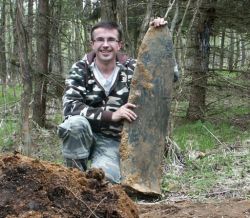 Being one of the volunteers in the Museum of Air Battle above the Ore Mountains in Kovarska, I developed a special place in my heart for the Mighty Eighth and especially for the 100th Bomb Group. Visiting the different crash sites of the B-17's of the Bloody Hundredth and helping with the excavations in the past, I decided to see the other side of the story which I read so much about. A decision to visit the airbases of the 13th Combat Wing was made.
(Photo: author with a recently discovered Bf 109G prop balde. This Messerschmitt was shot down in battle with the 100th BG and their fighter escort on 11 September 1944.)
Friday July 24, 2009
It’s early Friday morning and I can’t sleep anymore, it’s just too exciting. Today is a big day. After months of planning and preparations I’m flying to East Anglia to see the three bases the 13th Combat Wing used to operate out of. I departed Prague (Czech Republic) on a first morning flight to Amsterdam and then with KLM to Norwich, UK. As we climbed out of Amsterdam and started to head towards Norwich, I could see the cold, gray waters of the North Sea through the occasional cloud cover. As I looked out the window I could not stop to wonder how many crews came across the same waters more then 65 years ago, some with battle damage and some with wounded on board. As we approach Norwich, I caught the first glimpses of the Norfolk countryside and the white windmills. After the arrival to Norwich, I rented a car with a steering wheel on the wrong side, and it was also time to learn how to drive on the wrong side of the road. I had to learn fast – before I got to the first roundabout. A twenty mile drive to Dickleburgh was uneventful, as I started to get used to driving on the left side. It was early afternoon as I arrived to Dickleburgh and I decided to explore the area around Thorpe Abbotts first before checking in at the B&B. I parked the car on the east side of the field, with a view of the renovated control tower, and just sat there for I don’t know how long. So this is it, this is what used to be the base of The Bloody Hundredth I read so much about. As I started to walk down the east perimeter track, where the 349th Squadron hardstands used to be, I tried to imagine what it was like here with Fortresses parked at their hardstands. After returning to my car, as thunder clouds were approaching from the west, it was time to check in at the B&B. I booked 3 nights at the Moor View. This secluded, family run B&B is located near Dickleburgh, and Michael and Viki made me feel like at home. Later on in the evening after the afternoon thunderstorm I drove around the field again and this time stopping by the main perimeter track on the west side of the field. The gate was open, and I started to walk towards the tower. Standing in the middle of the perimeter track, I closed my eyes and took a deep breath; I could still smell the oil of the Fortresses that once inhabited this airbase.
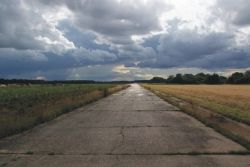
The main perimeter track at Thorpe Abbotts
As it was supper time now, I decided to visit one of the watering holes of the Bloody Hundredth, the Half Moon Inn in Rushall.
Saturday July 25, 2009
I woke up early Saturday morning, and looked out the window; I saw clear blue skies with only light wind. I could not wish for better weather for what I was planning to do this morning. A couple of weeks before my trip to East Anglia, I booked a flight in a Stearman, and I hoped for good weather for today. After an excellent full English breakfast at the B&B, I took a short drive to the Old Buckenham Airfield, a former WWII American bomber base. As I arrived early the Stearman was not ready yet so it gave me a chance to look around the field. Old Buckenham was the home of the 453th Bomb Group, in the 2nd Air Division of the Mighty Eighth. Today, only a small part of the original east-west runway is being used along with a newer turf runway. Gerry Honey, a former RAF Harrier pilot, is running a flight school with a couple of training airplanes plus the Stearman at this airfield. After meeting with Gerry, we briefed for the flight and looked over the chart and decided on the route of the flight as follows: Old Buckenham – Thorpe Abbotts – Hormam – Parham – Old Buckenham. It was now time pull the shiny 1941 Stearman out of the hangar.
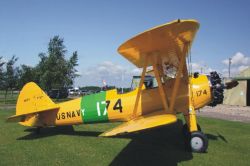
1941 Stearman
While Gerry did the pre-flight inspection, I had put on a leather jacket and a leather helmet with goggles. Because I wanted to take few photos during the flight it was agreed that Gerry would fly the first part of the flight and as I am also a pilot, I would bring the Strearman back to Old Buckenham. The 220 hp, seven cylinders Continental engine was started by Gerry and I scented the burned oil which remained in the cylinders. We taxied slowly towards the westerly runway, the same runway which was used by the B-24s more then 65 years ago. As we lined up for take-off, the radial engine started to roar and the tail of the plane came up shortly after that. We climb to five hundred feet above ground and started a left turn towards Thorpe Abbotts. The visibility was unlimited with only occasional cloud here and there. It was not long before the outlines of Station 139 became visible. We lined up for a low pass above what used to be the main east-west runway. After that, as a tribute to all the servicemen of the Bloody Hundredth, we circled the tower, and Carol and Gordon waved at us. A southerly heading took as right over what now remains of the main runway at Horham, and then over the city of Framlingham with it’s picturesque 12th-century castle and right over the Parham, the base of the square J. It was now time to fly back to Old Buckenham and Gerry gave me the controls. On the way back, we flew over Thorpe Abbotts again. My eyes were getting wet all of a sudden, must have been the wind blowing in my face. I was glad Gerry was in the rear seat and could not see me. When we arrived back at Old Buckenham, we did a low pass above the runway and then rejoined the traffic pattern for a perfect three point landing. Mission accomplished. I flew the Stearman and got a taste what it was like trying to earn the wings in the Air Corps during the WWII. Being a professional pilot myself, this was a dream come true.
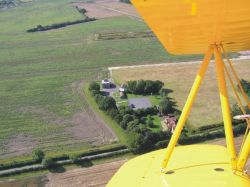
Circling above the tower at Thorpe Abbotts
When I arrived later on at the 100th Bomb Group Memorial Museum in Thorpe Abbotts, I was greeted by Carol Batley and we talked about all the news at the Museum in Kovarska and about the upcoming reunion in Albuquerque. Gordon and Carol gave me the grand tour of the Museum. As I stood on the tower balcony, I closed my eyes. The B-17s were lined up along the perimeter track awaiting a green flare. Look, look! There is Silver Dollar, and there is Fever Beaver, and Mason and Dixon. And over there in a distance is Mud in Yer Eye, and Now An' Then…
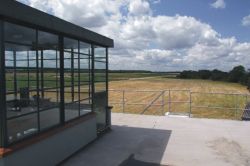
Thorpe Abbotts
Ron arrived later on and gave me a tour of the different sites located to the south of the airfield proper. We drove from site to site, and compared the actual remains of buildings and Nissen Huts to the photos in Contrails. Our last stop was the site of the 350th squadron. I asked Ron if it would be possible to bring home a brick from this site. Ron had found me a nice brick, but it was at a cost. As we made our way through five feet high nettles, Ron’s trousers were not as clean as they were just few minutes ago. On our way back we stopped at what now remains of the main runway, and I received a piece of the top tar layer from the main runway. How many times wheels of B-17s touched this piece of tar? The piece is now in a display showcase in the Museum in Kovarska.
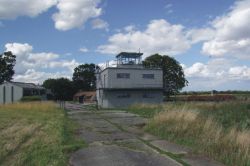
The renovated control tower at Thorpe Abbotts
Later on in the afternoon, I went to the top of the control tower again. As I looked to the east, I tried to imagine what it was like awaiting the return of the planes from a mission. I scanned the easterly horizon. I could not see any. I looked again. There are first six, and there are three more, no, no make that four. That makes it ten in total. And there are few more starting to show up as they peel off for landing. Will there be more? Maybe some landed at different airfields. Maybe… There is one more Fortress coming in for landing with two propellers feathered. Here come the red flares. Wounded on board. It will be OK now boys, just bring her home. Now, I can see it’s Heaven Can Wait, with its tail severely shattered.
After saying farewell to Carol, Ron and the rest of the volunteers, I departed Thorpe Abbotts. Realizing that I did not eat much all day since this morning, I decided to go for a supper at The Old Ram.
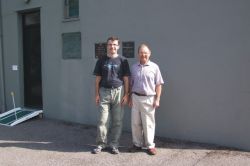
With Ron Batley
Later on in the evening, I went for a last walk along the old perimeter track towards the control tower at Thorpe Abbotts. The sun was settling down and the skies turned orange. I took a number of photos of the control tower with the sunset, and started to head back towards my car. I started to sing a song “Coming in on a Wing and a Prayer” by Vera Lynn. Oh boy, was I glad nobody was around to hear me, because I’m a really lousy singer. But it did not mater this time. Carol, Ron and all the volunteers at Thorpe Abbotts, you have done an amazing job. Thank you for the tour.
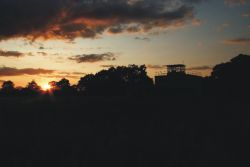
Sunset at Thorpe Abbotts
Sunday July 26, 2009
After a lovely breakfast, it was time to drive to Horham. My first stop was the monument of the 95th Bomb Group by the church in the center of Horham, along with the Dragon House, which used to be a pub. From then a short drive to the 95th Bomb Group Hospital Museum, that is located not too far from the Red Feather Club. One sure can get a good feeling what it was like here when the hospital was fully operational. I occasionally felt shivers down my spine, like looking at the dentist’s chair and the instruments. My next stop was the Red Feather Club. Right after I arrived, I was greeted by Frank Sherman and Alan Johnson. The volunteers at the Red Feather Club also did an amazing job in renovating the old building and saving the murals painted by Nathan Bindler. Frank showed me around the Club and we talked about the B-17G “Haard Luck”, which was shot down during the Ruhland mission on September 11, 1944. I promised Frank a piece of the actual Fortress which the Museum in Kovarska recovered from her final resting place near Schmalzgrube, Germany, so it could be displayed in their Museum in Horham. One of the items on display in Horham, which caught my attention, was the Melvin Spencer’s A-2 flight jacket along with the story of “The man who came for breakfast”.
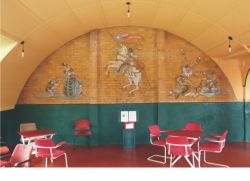
The Red Feather Club in Horham
After leaving Horham, I drove through the Suffolk countryside to Parham, the third and last base of the 13th CBW. A wonderfully reconstructed control tower of the 390th BG Memorial Air Museum can be seen from a great distance. Gerry Green and Kathleen Kindred gave me a nice tour of the base and later we visited different sites on the airfield, including the still standing cinema, chapel and Quonset huts. As I went up to the balcony of the control tower, I could see that not much remains of the old airfield. The main runway is long gone and the airfield is converted back to farm land, only some parts of the perimeter track still remain. As I stood there and looked where the main runway used to be, I saw farmers harvesting their field. Yanks and the Fortresses are long gone, but the spirit still lives on.
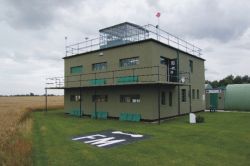
Parham – the home of the 390th Bomb Group
After a busy day, I went for a well deserved supper at The Horseshoes Inn (also known as Good Pull Inn) near Thorpe Abbotts. While waiting for my meal, I looked around the pub at some of the old beams and walls. If they could only talk. After all, this is the place where the airmen from the 100th Bomb Group came to drink the warm English beer as they awaited the next mission.
Monday July 27, 2009
My short stay in East Anglia was coming to the end. Few minutes before 10 o’clock, the wheels of the KLM Fokker 50 left the Norwich runway. I caught the last glimpse of the English soil on this wet and cloudy morning. Cheerio, Good Old England.
Written by Michal Holy
July 2009